Malaysia’s Employment Act 1955 provides a baseline of statutory protections for employees working in Peninsular Malaysia and the Federal Territory of Labuan. Following the major amendments that took effect in January 2023, the law now covers all employees regardless of wage level, though some provisions still apply only to those earning RM4,000 or less per month. The following sections explain the minimum leave entitlements employers must provide.
Annual Leave
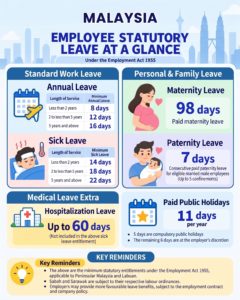
Annual leave entitlement is tiered according to an employee’s length of continuous service with the same employer. Employees who have worked for less than two years receive a minimum of 8 days of paid annual leave. Those with two to five years of service are entitled to 12 days, while employees who have served for more than five years receive 16 days.
Sick Leave and Hospitalisation Leave
The 2022 amendments separated sick leave from hospitalisation leave, creating two distinct entitlements. Ordinary sick leave is granted based on the length of service: less than two years of service entitles an employee to 14 days, two to five years to 18 days, and five years or more to 22 days.
For hospitalisation, employees are entitled to up to 60 days of hospitalisation leave per year. This is separate from, and additional to, the ordinary sick leave entitlement. The separation was introduced to ensure employees have sufficient time for treatment and recovery without exhausting their regular sick leave.
Maternity Leave
Female employees are entitled to 98 consecutive days of paid maternity leave, increased from the previous 60 days under the 2022 amendments. To qualify for full pay during this period, the employee must have worked for at least 90 days in the nine months preceding delivery and must have informed her employer of the pregnancy and expected date of delivery. Maternity leave may begin as early as 30 days before the expected delivery date.
Paternity Leave
The Employment Act 1955 introduced paid paternity leave for the first time through the 2022 amendments. Married male employees are entitled to 7 consecutive days of paid paternity leave. This entitlement applies for up to five births, regardless of the number of spouses. Eligibility requires that the employee be legally married and that the employer be notified of the wife’s pregnancy at least 30 days before the expected confinement, or as soon as possible after the birth.
Paid Public Holidays
Employees are entitled to a minimum of 11 gazetted public holidays per calendar year. Of these, five are mandatory and cannot be substituted by the employer:
-
National Day
-
Birthday of the Yang di-Pertuan Agong
-
Birthday of the Ruler or Yang di-Pertua Negeri of the state where the employee works (or Federal Territory Day for those in the Federal Territories)
-
Labour Day
-
Malaysia Day
The remaining six paid public holidays are at the employer’s discretion. Employers must display a notice specifying these chosen holidays conspicuously at the workplace before the start of each calendar year.
Important Considerations for Employers
Employers should note that employees in Sabah and Sarawak are governed by their respective Labour Ordinances rather than the Employment Act 1955. While recent amendments have largely standardised these laws with the Employment Act, some differences remain in public holiday entitlements and other provisions.
These entitlements represent minimum requirements. Employers may provide more favourable leave benefits through employment contracts or company policies. Failure to comply with these statutory minimums can result in penalties under the Act.